
How to choose space-saving furniture for small apartments when you’re living big.
Stop shrinking your furniture.
Every “space-saving furniture” list on the internet tells you the same thing: buy small stuff.
Get the tiny sofa. Get the fold-up-into-nothing table. Shrink everything until your apartment looks like a dollhouse and feels like one too. Bad advice. I’ve lived it, and I’m not doing it again.
Here’s the actual definition, since everyone gets it wrong: space-saving furniture is furniture chosen for how little visual weight it carries, not how little floor space it takes up.
Start choosing furniture that feels light.
Space saving furniture is giving the room air to breath.
How do you do this? Legs. Legs. Legs!
You don’t need to give up storage to do this.
By being able to see under furniture, you see more floor = more space in your mind.
Space-conscious pieces consider how you feel in the space.
You can have oversized furniture in a space, and it still feels good because there’s space in between for the energy to flow (lemme get woo woo for mo).
This leads me to my hot take:
Get the oversized sofa
What’s the point of a sofa if you can’t properly veg out on it??
Get one you can:
- disappear into
- host a movie night with the hunnies
- absorb a mate who’s crashing after flying in
A sofa’s whole job is to hold you and your people. Shrinking it defeats the purpose. Forget size. Visual weight is the metric that actually matters.
Disclaimer: the sofa does need to fit**
The space-conscious rule: does it disappear, or does it dominate?
This is where the scandi mcm designers won on comfort and style… light, slim armrests, low backs, and deep seats you can curl up with a cuppa across from your boo.
When you go small or heavy, your brain is like “damn its small in here”.
Feels like: [small/ heavy = emoji crossing arms vs big/ light = emoji hallelujah]
This be the whole trick to furnishing small without living small.
What to actually look for:
- Legs, not bases. Anything that floats off the floor lets your eye, and the light, travel underneath it. That gap is doing the heavy lifting…
- Soft curves over hard corners. Curves take up less room – this has gotta be scientifically correct.
- Low backs, minimal arms. Every centimetre of armrest is a centimetre you’re not sitting in. Skip the bulky arms, keep the width for buns.
- Deep seats. Counterintuitive, but a deep seat invites you to slump in and curl up, instead of perching on the edge like you’re at a bus stop. This is purely a rule for your enjoyment. You’re welcome.
My favourite proof of concept, and an genuinely rare find: the IKEA PS 2012 sofa. Legs, low profile, converts to a king single, aaaand there’s room to stash the stuff that doesn’t have a home yet underneath. If you ever see one secondhand, it’s your lucky day.
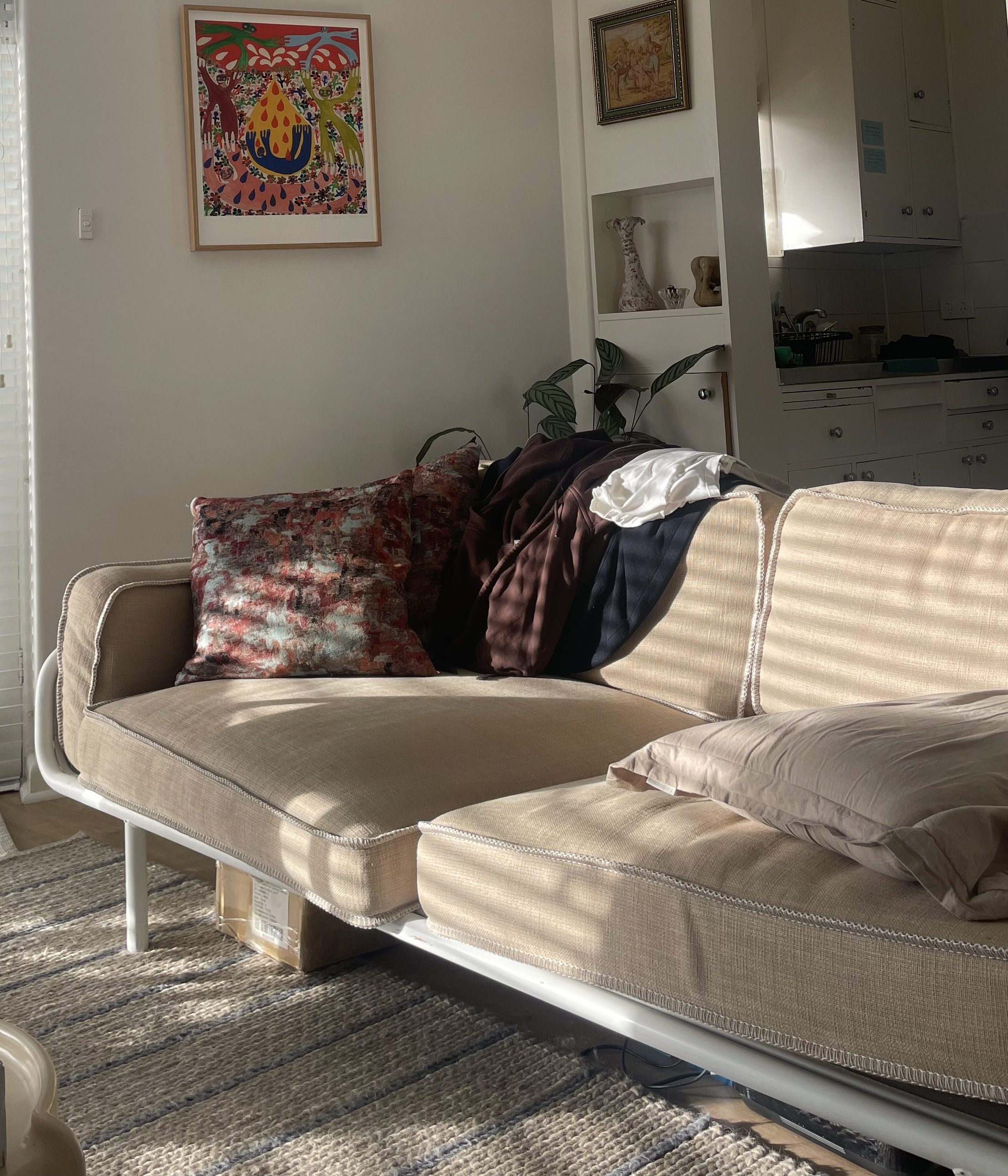
IKEA PS 2012
The stuff nobody warns you about
Measure the doorway. Not the room. (again for the peeps at the back). The doorway.
I downsized from a goooregous curved velvet sofa when I moved to a wee 1800s cottage in Fitzroy. We measured the room. We did not measure the doorway. Four of us, every angle we could think of, and it would not go in. It left a streak of green leather on the doorframe that never came out – a permanent little memorial to a couch that almost made it :’). Whatever you’re buying, if it ain’t flat-packed, walk the path it needs to travel before you fall in love with it.
Adjustability matters more than the spec sheet makes it look.
I bought an IKEA kitchen trolley/chopping block once that looked perfect on marketplace.
In real life: too low, fixed shelves that didn’t move for the ~compact~ air fryer, and the two-wheel thing got lame quickly. Whenever we wanted to move it, we had to ever so carefully tilt it not to knock the contents. Space-saving, sure, but mega annoying.
I ended up moving to a larger kitchen extension with a stainless steel bench in the hallway (yes a kitchen extension in the hallway – such is the life of small spaces) to give me more prep space and storage. It was bigger than the IKEA trolley (58cm x 50cm). Now, everything has a home and overall, the space feels so. much. better.
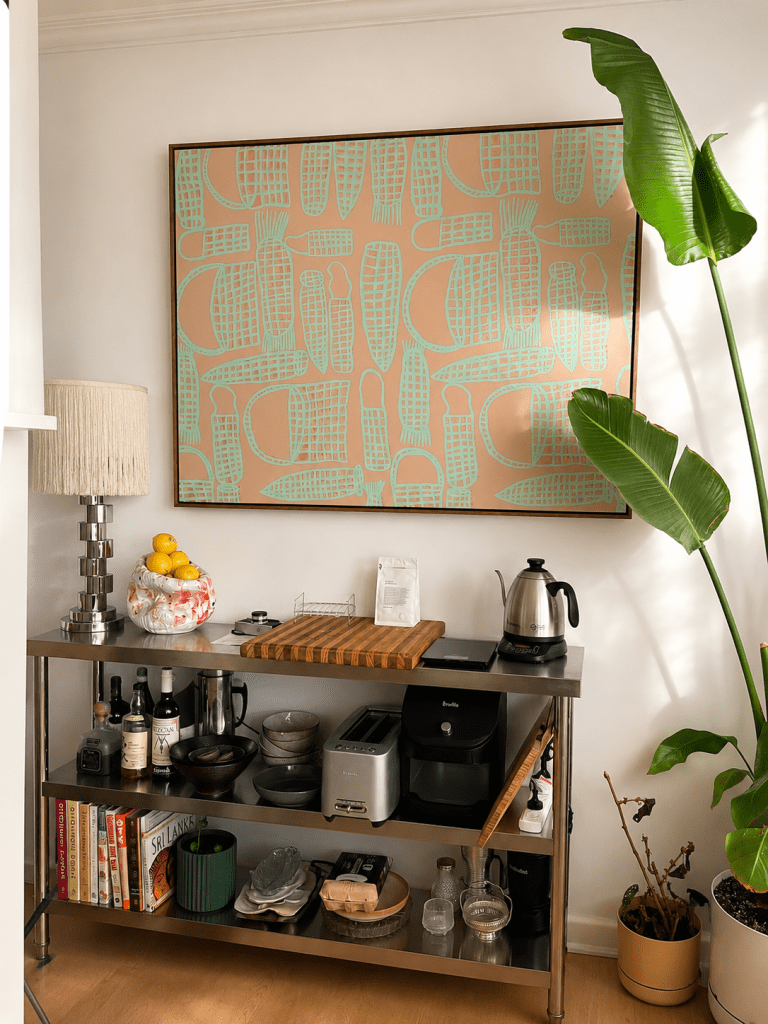
Snapped without styling – we’re slowly getting there, mm kay.
The right furniture beats smaller furniture, every time.
Swapping my beloved vintage burl but boxy bedside tables for a pair of Kartell bedside tables made the whole bedroom feel calmer. Added bonus, it was easier to reach for stuff from bed. Overall, less visual clutter fighting for attention.
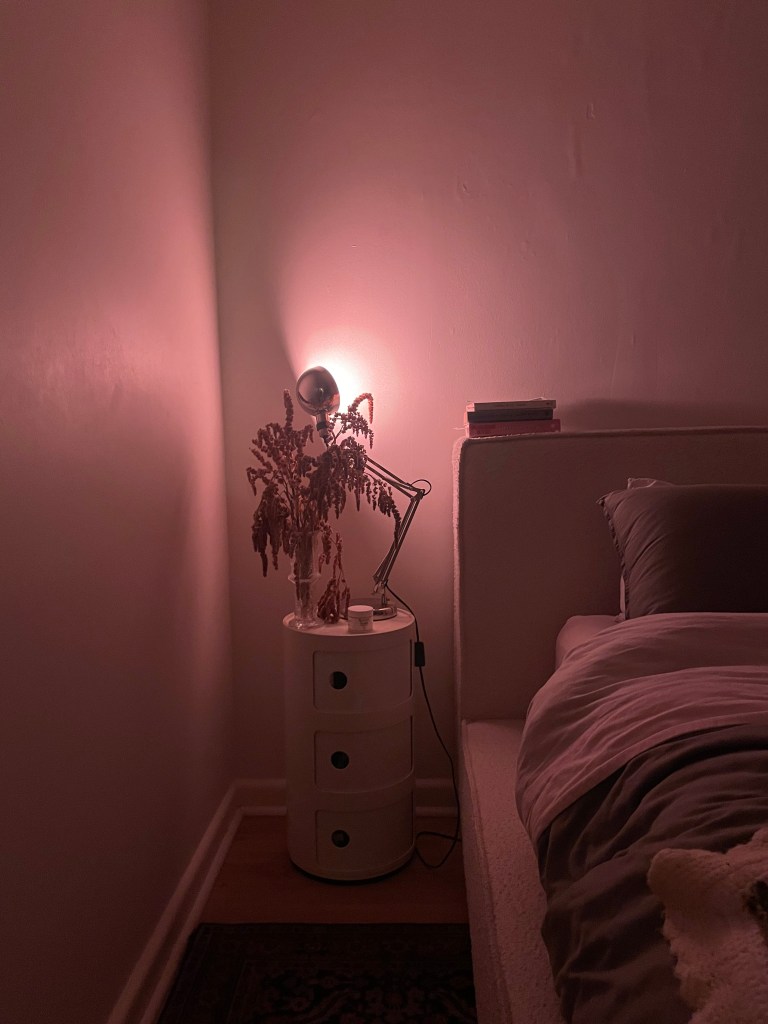
The point of all of this
I’ve done the 1960s mid-century one-bedder, the 1800s bluestone cottage, share houses in Berlin and Amsterdam where your bedroom was the place people came to hang out, study, decompress. Every one of those spaces taught me the same thing: the furniture that saves space earns its place, disappears when you need it to, and still lets you actually live in the room instead of just fitting inside it. Floor space was never the real metric.
That’s what we’re building out from here: space-saving sofa beds and modular pieces that don’t scream “I compromise,” space-saving desks that fold away without falling apart, extendable dining tables that gain a seat when your friend from out of town needs one, and clever storage solutions that hide in plain sight.
All of it judged against the same question: does this make the room feel bigger, or does it just take up less of it?
Those are different things. Most furniture gets this wrong. We’re not going to.
Quick answers
Is space-saving furniture the same as multifunctional furniture? Not quite. Multifunctional furniture does two jobs (a bench that’s also storage, a table that’s also a desk). Space-saving furniture is about how a piece reads in a room. The best pieces are usually both, but they’re solving different problems.
Does space-saving furniture cost more? Sometimes, if good joinery and proper mechanisms are involved, it’s gonna add up. But buying the wrong shape twice costs more than buying the right one once. Ask the trolley with two wheels how that math worked out.
What’s the one thing to check before buying any small-space piece? The path it has to travel to get into your home. Not the room it’s going in – think about the doorway, the stairwell, the lift. Measure twice. Walk the path.
Smol Spaces is Melbourne based, helping folks with small spaces live big.
If there were one space saving furniture rule you’d make universal, what would it be?
 smol spaces
Leave a comment